This Tech Corner will review the evolution of the parking brake in the various generations of corvettes.
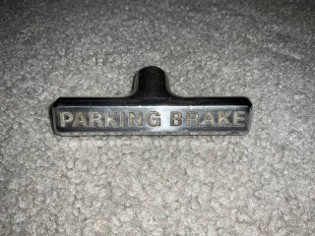 C1 (1953-1962) and C2 (1962-1967) Corvettes
Underneath the dashboard and body, the T handle is connected to a complex mechanical linkage. Pulling the handle moved a heavy-duty under-car lever, which pulled steel cables channeled through specialized frame guides and pulleys to activate the rear drum brakes. To engage the brake, you pulled the T-handle straight out from the dashboard. To release it, you twisted the handle slightly to clear the internal ratchet mechanism and pushed it back into the dash.
 C3 (1968-1982) Corvettes
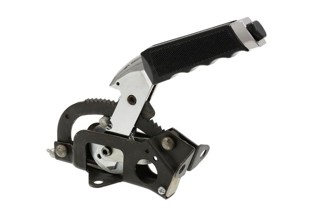
A C3 Corvette parking brake operates via a mechanical hand lever inside the console connected to a cable system that actuates small internal drum brake shoes hidden inside the rear disc brake rotors.
To engage pull the handbrake lever upward until firm resistance is felt and the car is held securely.
To release pull the lever up slightly to depress the release button, then push the lever all the way down to the floor.
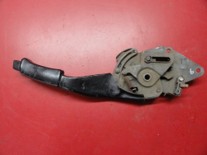 C4 (1984-1996) Corvette
Most C4 setups use a mechanical cam built into the rear brake caliper or an internal mini-drum shoe setup inside the rotor hub, depending on the model year.
Location the handle is tucked tightly in the corner beside the driver’s seat rather than the center console.
The handle contains an automatic adjustment mechanism rather than manual under-car cable nuts, though slack can sometimes be managed or reset via the lever assembly under the driver’s seat cushion.
Setting the Brake: Pull the lever up, then push it back down to the floor; the down position means the brake is locked and enable the driver to exit the car
Releasing the Brake: Hold the foot brake down, pull the handle up until you can press the release button, then hold the button and push the lever completely down.
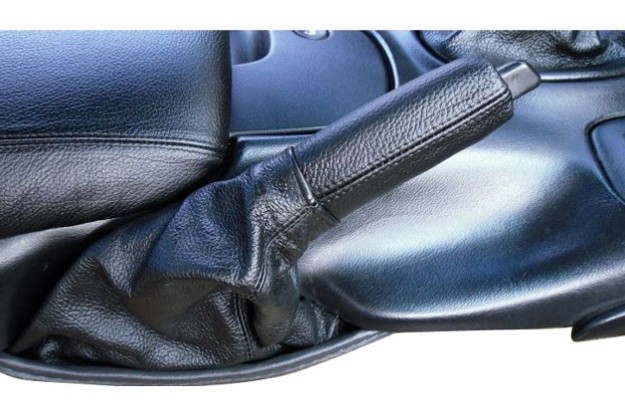 C5 (1997-2004) -C6 (2005-2013) Corvette
Location: Positioned right next to the driver’s seat on the center console tunnel.
Operation: Pull the lever up to engage the parking brake and press the end button down to release it.
The C5 and C6 parking brake system consist of three subassemblies: 1) the parking brake lever, 2) parking brake cables and actuators and 3) small, drum brakes inside the rear disc rotors. The systems are the same for both generation except so minor cosmetics on the handles. The handle controls a mini drum-in-hat shoes inside the rear rotors.
There are two adjustments to this system. The first is the “parking brake cable automatic adjuster”. To enable that, apply and release the parking brake handle three times. The second adjustment is the one few Corvette DIYs do and that’s the “parking brake adjustment” which sets the proper clearance between the parking brake shoes and the drums inside the rear rotors.
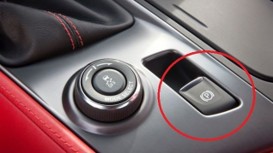 C7(2014-2019) Corvette
Interior Switch: The red circle highlights the EPB finger switch situated on the driver’s side of the center console trim, right next to the traction/mode selector knob.
Actuator Module: Unlike vehicles with motorized calipers, the C7 uses a centralized electric actuator module mounted beneath the car that mechanically pulls tension cables.
Rear Internal Drum: At the wheel hub, the system utilizes a traditional “drum-in-hat” design. The spring-loaded brake shoes push outward against the inner hat of the rear rotor.
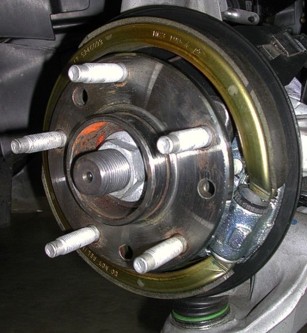 To Apply: Ensure the vehicle is at a complete stop, then pull up momentarily on the EPB switch on the center console. An indicator light will show on the dash once engaged.
To Release: Turn the ignition to ACC/ACCESSORY or ON/RUN, press and hold the regular foot brake pedal, and push down momentarily on the EPB switch or put the car in gear.
C8 (2020-Current) Corvette
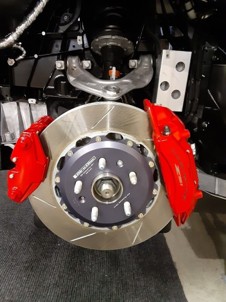
The C8 Corvette utilizes a Motor-on-Caliper (MOC) principle. Instead of the main hydraulic piston being driven by fluid to hold the car, dedicated electric motors are mounted directly on the rear brake calipers
The Chevrolet Corvette C8 uses an Electronic Parking Brake (EPB) system controlled by a small toggle switch on the lower left side of the dashboard/center console area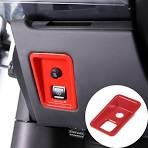
How to Engage the Parking Brake
- Stop the car completely.
- Press and hold the regular brake pedal.
- Press the EPB switch (labeled with a “P” inside brackets or “Park Brake”) down or pull/press depending on the toggle action; a light on the dash will confirm it is set.
- You can then shift the transmission into Park (P) via the center console buttons.
 How to Release the Parking Brake
- Turn the ignition ON or start the engine with your foot depressing the brake pedal.
- Hold the brake pedal down firmly.
- Press the EPB switch momentarily while keeping your foot on the brake or simply put the car into Drive (D) or Reverse (R)—the system will release automatically if doors are closed and the seatbelt is buckled.